
How Can We Help?
NMJL CARD FAQS (ARTICLE 254)
Each April, the National Mah Jongg League (NMJL) releases its highly anticipated annual card—a fresh layout of hands that sets the tone for the year ahead. Players across the country receive their new cards by mail or through local collectors, eagerly flipping through to discover what’s changed. With the new card in hand, players enter a transition period as they adjust to updated combinations and refine their strategies. Whether you’re a seasoned player or just getting started, adapting to the new card is a vital part of the NMJL cycle and an exciting opportunity to deepen your skills.
To transition to the new card, many experienced players start by comparing it to the previous year’s version, looking for patterns, changes, and returning favorites. Some even publish their findings to help others get up to speed. You can do this yourself or benefit from the insights others have shared.
The duration of the transition depends on your familiarity with the NMJL game theory and the frequency of your play. Playing often, making careful observations, and engaging in intentional study will help you gain confidence. Be patient with yourself—adjusting to the new card is a learning curve for everyone.
The 2026 NMJL card contains some complex hands and valuation oversights to be aware of. This FAQ article highlights the key issues so you can play with clarity, confidence, and fewer moments of confusion.
Scroll to the bottom of this article, then click the button to watch a video with the nitty-gritty details. Be sure to check the video description for the free e-book.
Hand FAQs
The inside of the card provides a menu of valid hand combinations across multiple categories, listing all available options for play. The following are frequently asked questions about the new card.
I ordered my card in January and haven’t received it yet! When will I get my #@*% card?!
If you purchased your card before mid-February, you should receive it any day. If you bought it later than that, you may not receive it until late April. Patience will serve you well. In the meantime, learn from instructors, creating content with examples until you receive your card.
Which hands are the same as last year’s?
These hands made the carry-over cut:
- Evens #5
- Odds #7
- Winds-Dragons #1-1, #1-2, #8
- Singles and Pairs #6
Does the pair of Dragons need to correspond to the pair of like numbers?
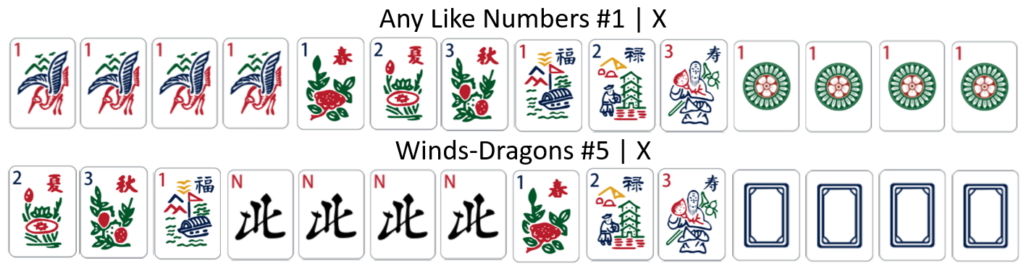
When the league uses the word “ANY” in the parentheses, it gives you freedom to choose which tiles you use within that structure, which makes the named blocks autonomous. The colors tell you how many suits are involved. For example, Any Like Numbers #3, the colored numbers (green, red, blue) tell you to use all three suits.

In Consecutive Run #2, can the three-number sequence exist anywhere in the sequence?
The text in parentheses allows either 1 or 3 suits with a 5-number sequence. After the pung of flowers, the chow must be in the middle of the sequence. I call it the “nested chow” hand.

In Quint #3, must the two number tiles in one suit be consecutive?
The text in parentheses says the hand may use any two numbers in one suit, plus any off-suit dragon (e.g., opposite).

Does the pair need to come first in Odds #4?
This hand requires a block of one of each category number with any tile paired, plus kongs of the paired tile in the other two suits. This is known as a floating pair hand, so the pair does not need to start the block, but it must match the kongs. For example: 135779 dots, 7777 bams, 7777 craks; FF 3699 dots, 9999 bams, 9999 craks

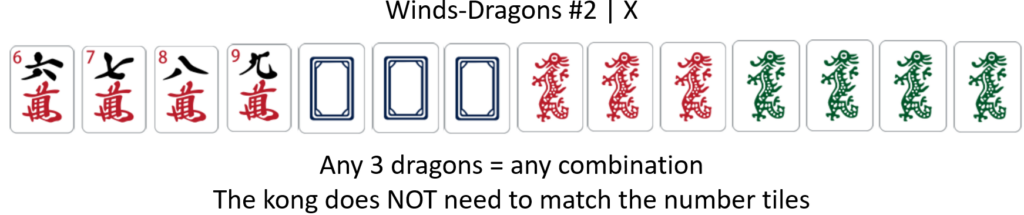
Must the four numbers be the same suit as the four dragons in Winds-Dragons #2?
Some players get tripped up by the word “ANY” on the card. When the league uses “ANY” in parentheses, it gives the player flexibility—each named block is autonomous from the others.
“ANY” means you choose how to build that part of the hand, independent of the rest.
For example, in Winds-Dragons #2, the hand calls for any four consecutive numbers in one suit, with any three dragons. The dragons must be three different dragons, arranged as two pungs and one kong—but you decide which dragon is the kong. It does not need to match or correspond to the number tiles.
When you see “ANY,” think autonomy—not connected.
Do the winds need to be in the shape and order shown on the card?
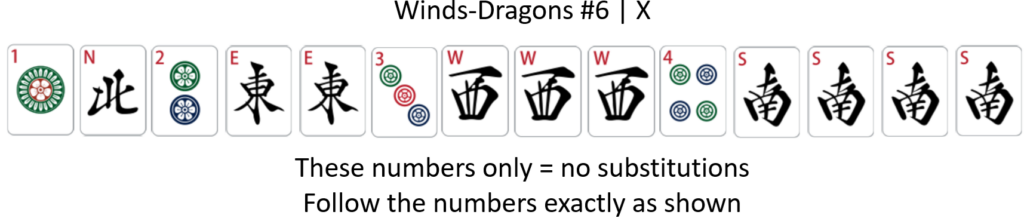
Winds-Dragons #6 is to be taken literally, so the numbers, shape, and order must be just as it is shown on the card: ONE North, TWO Easts, THREE Wests, FOUR Norths.
Why are there hands with two pungs of flowers and hands with a block of six flowers?
Having two pungs of flowers in a hand, rather than a sextet, gives players more flexibility. With double pungs, a player can develop the hand in pieces, claiming a discard to complete one pung at a time. That allows for faster hand development through calling and exposure.
A sextet, on the other hand, is a single block. It cannot be built incrementally through multiple calls.
The double-pung structure supports a more active, step-by-step path to building the hand, while a sextet is an all-in commitment.”
Why is 369 #5 a lower value than Odds #7 when they have the same components?
Three out of the 72 hands have been undervalued, which could impact decision-making and scoring outcomes.
Here are two hands for comparison, one is a 35-point concealed hand, and the other is a 30-point exposable hand.


The following hands are undervalued:


These oversights may lead players to misjudge the difficulty or the likelihood of completing these hands, affecting overall gameplay and strategy. Players must use good judgment when selecting hands and adjust their approach to account for these discrepancies to remain competitive.
Can I use evens with North and South and odds with East and West?
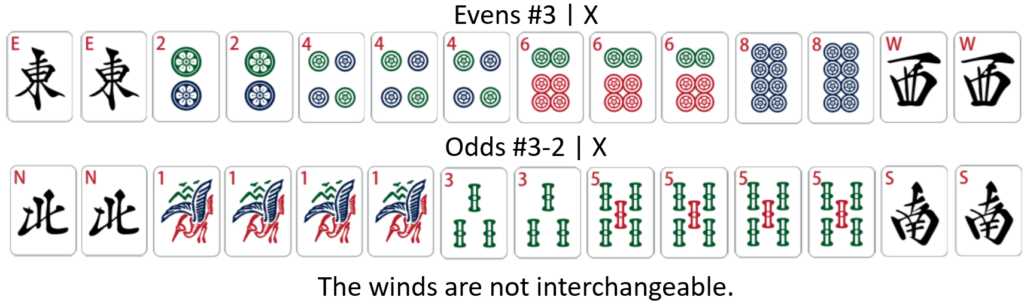
Some hands require odd-numbered tiles for North and South, and even-numbered tiles for East and West. For these hands, the combinations are not interchangeable. The same concepts are used in Winds-Dragons #3 and #4, so the winds must be as shown with odd and even number tiles, respectively.
Can I claim a discard to expose a pung of flowers hand with a sextet?
No. The spaces between the letters and numbers for a hand on the card are blocks. A player can claim a discard to expose (meld) any block of three or more identical tiles.
Double pungs allow a player to take a progressive approach to hand development because they can claim a discard to complete one pung at a time. A sextet requires an all-in commitment.
Select Standards FAQs
The league provides basic rules and guidelines on the back of the card. Due to limited space, this is not a comprehensive reference.
What do we do when two players want the same discard?
Rules #5 and #6 on the first panel explain what should happen when two players want the same discard for the same reason; the player next in turn gets the tile. However, if the player next in turn is not paying attention and another player claims the discard by racking it or exposing tiles, it’s too late for the player next in turn. Learn more: https://mahjlife.com/wiki/simultaneous-call-for-a-discard-both-for-exposures-article-93/
Can I make changes to my exposure?
Rule # 7 on the first panel correctly explains that changes can be made to an exposure during a player’s turn. A player may adjust the number of tiles (e.g., pung to kong, kong to pung) and type of tiles (e.g., flower, suit, wind, dragon, joker from the hand) in an exposure up until they have discarded. It appears that a player can correct any mistake during their turn, but that is not the case. Here are three related situations that should be considered:
- Exposures made earlier in the game cannot be changed (Article 6).
- If a player racks the wrong discard by mistake, they can be disqualified (Article 90).
- If a claimed discard is racked or tiles are exposed, the player is committed to using it. They can be disqualified if they can’t follow through (Article 24).
Watch the video and download the free companion eBook for a side-by-side look at what’s new, what’s changed, and what to watch out for. Whether you’re a seasoned player or just getting started, this guide will help you make a smooth transition.
FREE eBook link in the video description! #MAHJLIFE