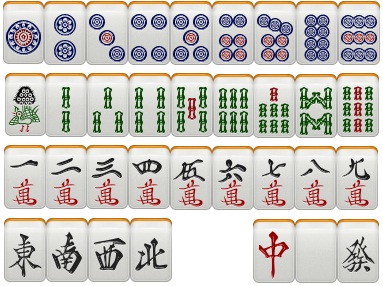
Mah jongg is a Chinese tile game requiring critical thinking, situational awareness, and social aquity to play well. Some players liken the game to Rummy or Poker. The name of the game roughly translates to “sparrow.” Some say the game was invented around 500 BC, but the earliest archeological evidence dates back to the 1880s. There are many theories about who invented the game, including Taiping Rebellion soldiers, a Chinese princess, a Shanghai aristocrat, two Ningpo brothers, and even Confucius himself. Regardless, it is an intriguing game of skill, strategy, and luck that has lasted through the ages. In the beginning, the game was played only by royalty. It was illegal for commoners to play. In the 1900s, the restriction was lifted, and the game gained popularity throughout Asia and eventually made its way to European countries in 1920. In 1923, the game was brought to the United States by Joseph Babcock, who standardized the rules for Americans and named the name “mah jongg.”
Chung Fa
Ma Chiang
Ma Chong
Ma Deuck
Ma Que
Mah Cheuk
Mahjong
Pe-Ling
Pung Chow
Que Ma Que
All versions use 136 tiles based on Chinese characters and symbols. The tiles consist of 4 suits, 4 of each tile including Dots, Bamboo, and Characters, numbered 1 through 9, and Honor tiles consisting of Winds and Dragons. Some versions also use jokers, flowers, and animal tiles. Players start with thirteen tiles, and the game’s object is to be the first player to complete a valid hand by drawing or melding discarded tiles. The rule set determines valid hands. It’s like building a puzzle with three opponents vying for the same pieces.
Honor the old.
Embrace the new.
At last count, there are 47 ways to play mah jongg. Following are the styles most commonly played in the United States (click title to learn more):
I don’t simply teach mah jongg. I help people think differently.
Whether I’m working with players, instructors, or audiences, my goal isn’t just to transfer knowledge—it’s to create meaningful shifts in the way people think. When people begin thinking differently, better decisions naturally follow.
That’s why my teaching focuses on more than skills alone.
With American mah jongg, I don’t teach memorization. I teach decision-making.
With competitive play, I don’t teach aggression. I teach judgment.
With instructor development, I don’t teach lesson plans. I teach educational thinking.
Through speaking and coaching, I don’t teach presentation techniques. I teach how to educate, influence, and inspire.
My hope is that every lesson, presentation, and conversation leaves people with more than new information. I want them to leave with a new perspective they can apply long after the learning experience ends.
Live Lessons
Ready to take live lessons? There are options for both in-person and virtual lessons
Owls are considered to be one of the most mysterious of all birds. They blend in with their surroundings and silently watch with their all-knowing eyes. Owl symbolism and meanings include knowledge, wisdom, intuition, independent thinking, and observant listening – all traits of a skilled mah jongg player. The connection for mah jongg fanatics is that, in some sets, the design of the one bamboo tile is adorned with an owl. The Mahj Life owl’s given name is Kiko which means “hope” in Japanese.