
How Can We Help?
MAH JONGG CRUTCHES (ARTICLE 220)
A crutch is something that someone depends on for help and support. In mah jongg, it’s a mechanism for helping someone when playing the game. Crutches may seem helpful temporarily, but they can have a broader impact than one might think, including negative effects on the game and all the players.
Reference Materials
Reference materials can be valuable during lessons and guided play as newcomers learn the game. In casual or competitive play, however, using materials beyond the current NMJL card should not be assumed to be acceptable. The group should agree beforehand whether supplemental references are permitted, since they may give a player an unfair advantage and can affect the pace of play.
Staging
Players must maintain 13 tiles on their rack at all times, except during the Charleston or during an active turn when temporarily holding a 14th tile. Brief exceptions during joker exchanges or while rearranging tiles are part of normal play (https://mahjlife.com/wiki/wrong-number-of-tiles-article-205/).
Some players use “staging” areas to help them with decision-making. Placing tiles on your card or holding them in your lap instead of keeping them on the rack breaks the rule. Also, the flat top of the rack is intended for exposures. Some players use this area to hold potential discards, or Plan B tiles. If a player uses staging, it can result in disqualification.
The rack helps maintain a clear distinction among concealed, exposed, and discarded tiles. Using it as intended keeps the state of the hand clear to everyone at the table.
Tail on the Wall
Each player turns the last stack of tiles so that it is perpendicular to their rack when building the walls. When it’s time to pick tiles from their wall, they push it out to a 45-degree angle, and the last stack of tiles in the wall is turned as a reminder to pick from the other end. Most groups call this a tail, which is also known in some circles as a caboose.
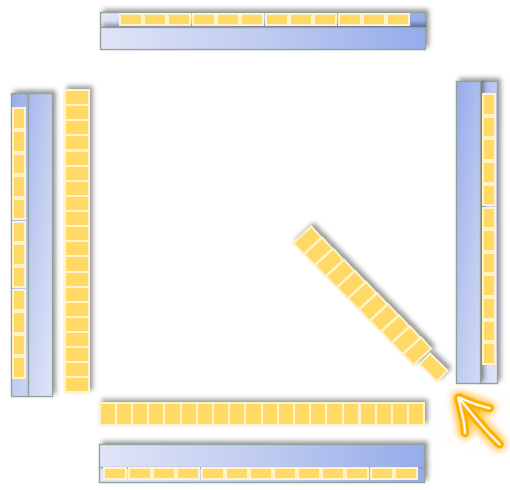
This can become a crutch that someone relies on. When someone plays with a group that does not allow it (e.g., experienced players, tournaments), they may be unsure which end of the wall to pick from because they have not trained their mind to choose the tile closest to the table’s center.
Additionally, experienced players who view it as unnecessary may scrutinize anyone who relies on a tail. This is usually not acceptable to do during a tournament.
Tombstone
Some tables use a house rule where, after a discard is claimed, the discarder stands the tile upright in front of their rack. The idea is to mark whose turn it was in case the caller changes their mind, and to make it easier for the caller to identify the correct tile.
The challenge is that this practice can quietly shift from a simple aid to a dependency. Once a player gets used to having a visual marker, they may struggle in settings where the cue isn’t used. It can also draw unwanted attention; seasoned players who consider the habit unnecessary sometimes view it as a sign of inexperience. In tournament play, where consistency and rule-based procedures matter, relying on improvised cues like this is discouraged.
A long-term approach is to train your eyes and mind to stay focused—tracking turn order and listening for calls—so your judgment rests on awareness rather than on cues that won’t always be present.
Coaster
This is similar to Tombstone. Instead of standing the discarded tile upright, it’s placed in a little decorative bowl or coaster in the center of the table.
The Tombstone challenge and the long-term approach apply.
Dead Jokers
During the game, players may have exposures with jokers. Any player with the natural tile can exchange it for the joker. When all the natural tiles used for exchange are visible (i.e., discarded or other exposures), the joker is no longer eligible for exchange and is turned upside down.
One benefit of playing mah jongg is that it allows you to practice critical thinking as you survey the discards for tiles. However, this opportunity is waived when using this mechanism.
Discard Formations
Chronological Discards
Players line up their discards in order of play, creating a visible sequence.
Pillars
Each new discard is stacked directly on top of—or grouped tightly with—the previous one, forming a column or cluster.
Last One Up
Before discarding, a player flips over the previous tile so that only the most recent discard is visible.
These methods take time to maintain and can slow down the game.
There is no rule governing discard formations in American mah jongg, but traditionally, discards are scattered randomly in the center of the table. Surveying discards is a critical thinking skill developed through play. Relying on structured discard formations removes that challenge and can be viewed by experienced players as unnecessary or even distracting.
Hand Highlighters
Anyone learning how to navigate the card or who has trouble with short-term memory may find it helpful to mark potential hands with a ruler, sticky highlighter, or post-it tab.
Sticky Highlighters:
- Muted tones: https://tinyurl.com/4n4apabe
- Pastels and brights: https://tinyurl.com/y36e8anm
This mechanism can be exploited by other players if used in person. Consider using a card cover or turning it over when it is unnecessary to block wandering eyes.
Shout-out to Shawn Martin for inspiring this wiki article. Shawn is a member of the Mahj Life Instructor Guild serving the Greater Atlanta area. You can learn more about her by visiting her instructor profile: https://mahjlife.com/instructor-guild-directory/name/shawn-martin/