
How Can We Help?
When One Step Forward Becomes Two Steps Back (Lesson Case Study 20230517)
Mahj Life Instructor Guild, Founder and Leader
Setting:
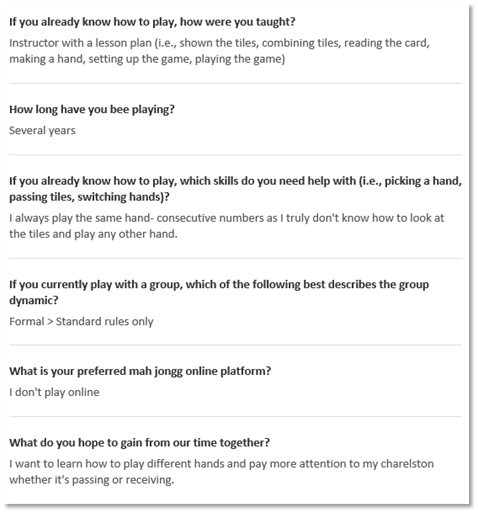
A one-on-one coaching session with an adult learner who completed an intake form prior to the lesson. The form was thorough and seemed to indicate prior experience with American Mah Jongg.
Scenario:
Based on the intake responses, the instructor expected the student, Joanne (name changed), to already understand gameplay and simply need help recognizing opportunities beyond the Consecutive Run category. The plan was to strengthen her card interpretation and expand her familiarity with Evens, Odds, and 369—collectively known as the V-Zone.
However, when the session began, it quickly became clear that Joanne’s experience level had been overestimated. Though she was warm, engaged, and eager to learn, she displayed signs of mild cognitive impairment, which made retaining new concepts and connecting patterns challenging.
What Happened:
The lesson began with a hand-development presentation, but when Joanne expressed confusion about how Dragons were used, the instructor pivoted. The plan shifted from advanced strategy to reinforcing fundamentals using the AMJ Run-Through framework. From there, the session focused on building understanding through Random Pulls and Charleston Modeling.
Throughout the exercises, Joanne asked repeated questions about color associations on the card, joker usage, and suit organization. She also consistently returned to her comfort zone—Consecutive Run—forgetting her goal to branch into other categories.
To reinforce learning, the instructor moved the session online using I Love Mahj’s Exercise Room to continue Charleston modeling and practice decision-making with bots.
Challenges Identified:
- Misinterpretation of the intake form, leading to an overestimated skill level
- Cognitive barriers requiring slower pacing and frequent repetition
- Need to continually reframe expectations mid-lesson
Instructor’s Reflection:
This experience highlighted the importance of verifying understanding before advancing to higher-level concepts. The instructor realized that doing a Charleston Modeling exercise at the start of a coaching session is an excellent diagnostic tool—it quickly reveals how well a student grasps basic mechanics, suit colors, and joker application.
Mahj Life Mentor Insight:
When working with learners who may show signs of cognitive decline or memory challenges, patience and observation are key. Start every session by:
- Reviewing the intake form together to clarify assumptions.
- Conducting at least one Random Pull or Charleston Modeling exercise while asking the student to verbalize their decisions.
- Listening for repeat questions to identify where reinforcement is needed.
- Summarizing instructions throughout the session and providing a follow-up email with clear exercises and visuals.
Instructor Takeaway:
Not every coaching session will go as planned, but flexibility and compassion ensure learning still happens. By shifting focus from strategy to fundamentals, the instructor preserved confidence and provided meaningful growth. For returning players or older adults, early diagnostic exercises and verbal reasoning tasks can reveal skill gaps that reshape the lesson plan before deeper frustration sets in.
Discussion Prompt:
How can you design your first 10 minutes with a student to confirm their current skill level and learning readiness—especially when prior experience may be unclear?