
How Can We Help?
EXERCISING CHARLESTON OPTIONS (ARTICLE 218)
A hand of mah jongg is divided into two phases: the Charleston phase and the pick-and-discard phase. The purpose of the Charleston is to allow you to transform your dealt hand by participating in a series of passes between opponents. There are two rounds of passes, and in both rounds, you will pass three unwanted tiles to your opponents in three passes. The first round is compulsory (right-across-first left), and the decision to continue into the second round must be unanimous. Once the second round is underway, you must complete it.
You cannot change your outgoing pass after viewing an incoming pass. Also, no rules stipulate when tiles from an incoming pass can be racked. Waiting until everyone has their incoming pass helps keep the process smooth. Also, it’s courteous to wait to give another player an outgoing pass until everyone has racked the tiles from the previous incoming pass.
You can take advantage of three additional options during the Charleston. Still, these options should only be exercised after careful consideration because exercising these options can alert vigilant opponents to the level of hand development you have achieved. Let’s look at each option’s when, why, and how.
Heavenly and Earthly Hands
There is one exception to the obligatory first round. If East recognizes they have a winning hand before the Charleston begins, they can declare mah jongg. This is called a Heavenly Hand and is worth double the hand’s value. The second round is optional (second left-across-last right). If East has a winning hand after the first round, they can declare mah jongg. This is called an Earthly hand and is also worth double the hand’s value.
Option 1: Passing Blind
You can pass up to three tiles “blind” on the last pass of each round (e.g., first left, last right). This lets you keep a well-developed hand intact. You may use one or two tiles from your incoming pass, sight unseen, to supplement tiles from your hand, or pass all three incoming tiles blind without contributing any tiles from your hand. If you look at the tiles you intend to pass blind, you are not only breaking the rule but also giving yourself an unfair advantage over your opponents.
Option 2: Stopping the Charleston
After the first left, any player can stop the Charleston without giving a reason. Since the second round is optional, it is a courtesy for someone to ask whether everyone wants to continue. In some groups, the player in the East seat takes responsibility for asking. However, each player is responsible for speaking up if they want to stop the Charleston. You cannot rely on someone else to ask.
Timing matters. If no one says anything and you want to stop, you must speak up before another player picks up and looks at their incoming second-left pass. Once that happens, you are committed to continuing. To prevent someone from forging ahead, the best time to speak up is when you receive your first-left pass. You don’t need to give a reason; simply say, “I may want to stop the Charleston.”
Strategically speaking, if you know what hand you are playing and have fewer than three tiles to pass, consider stopping the second round. If you are between categories or hands, stopping the second round is ill-advised because it only delays the inevitable. Instead, choose your strongest option and proceed to the second round to take full advantage of every opportunity.
While it does not explicitly say that a player who stopped the Charleston can still participate, Mah Jongg Made Easy clarifies that the optional across is always available at the end of the Charleston (Mah Jongg Made Easy, 2024, p. 13, Optional Pass). That means even a player who ended the Charleston is eligible. The player opposite them must then decide whether to participate.
Incidentally, it is customary to form a pyramid by placing one tile on top of the other two to indicate the first pass of the second Charleston. The formation is known by other names, including biscuit, cookie, hat, house, and stack. This custom does not appear in Mah Jongg Made Easy or League bulletins.
Option 3 Participating in the Optional Across Pass
The optional across pass, also known as the courtesy pass, offers you one last opportunity to refine your hand and strengthen your position. A player who stopped the Charleston is eligible to participate, but whether or not to participate is entirely up to you.
In Mah Jongg Made Easy, it says, “After you have completed the three passes in the first and/or second round you have the option to make one final pass. This pass is always the last pass of the Charleston. The number of tiles exchanged in this pass is dictated by the player wanting the fewest number of tiles. One, two, or three tiles may be passed to the player sitting opposite. If a player does not want to exchange any tiles, no optional pass is made to the player’s left. (Mah Jongg Made Easy 2024 pg. 13)” The League provides no further instruction, so players are free to act in their own best interest. The optional across becomes a negotiation: one player makes an offer, and the other may accept, counter, or decline if they feel the exchange favors their opponent. Offers can also be withdrawn, in which case the other player must concede.
If your opponent passed blind or stopped the second round, it may be wise to decline their offer. They likely have a well-developed hand, and passing them tiles could give them a significant advantage.
Commitment to a Pass
A player can look at or change the tiles they have passed if they have not yet looked at their incoming pass from the other player. A player is committed to following through with a pass once they have picked up the incoming pass from the other player (NMJL bulletin 2025).
Charleston Courtesy: Nice to Do, Not Required
No official rules require players to wait to look at incoming passes or to delay passing their tiles during the Charleston. These practices are courtesies, not obligations. While some players prefer a more synchronized rhythm during the Charleston, others may pick up and pass tiles at their own pace. Respecting these differences helps keep the game smooth and enjoyable for everyone.
For timing, passing procedures, and table etiquette during the Charleston, see Charleston Protocols and Etiquette (Article 300).
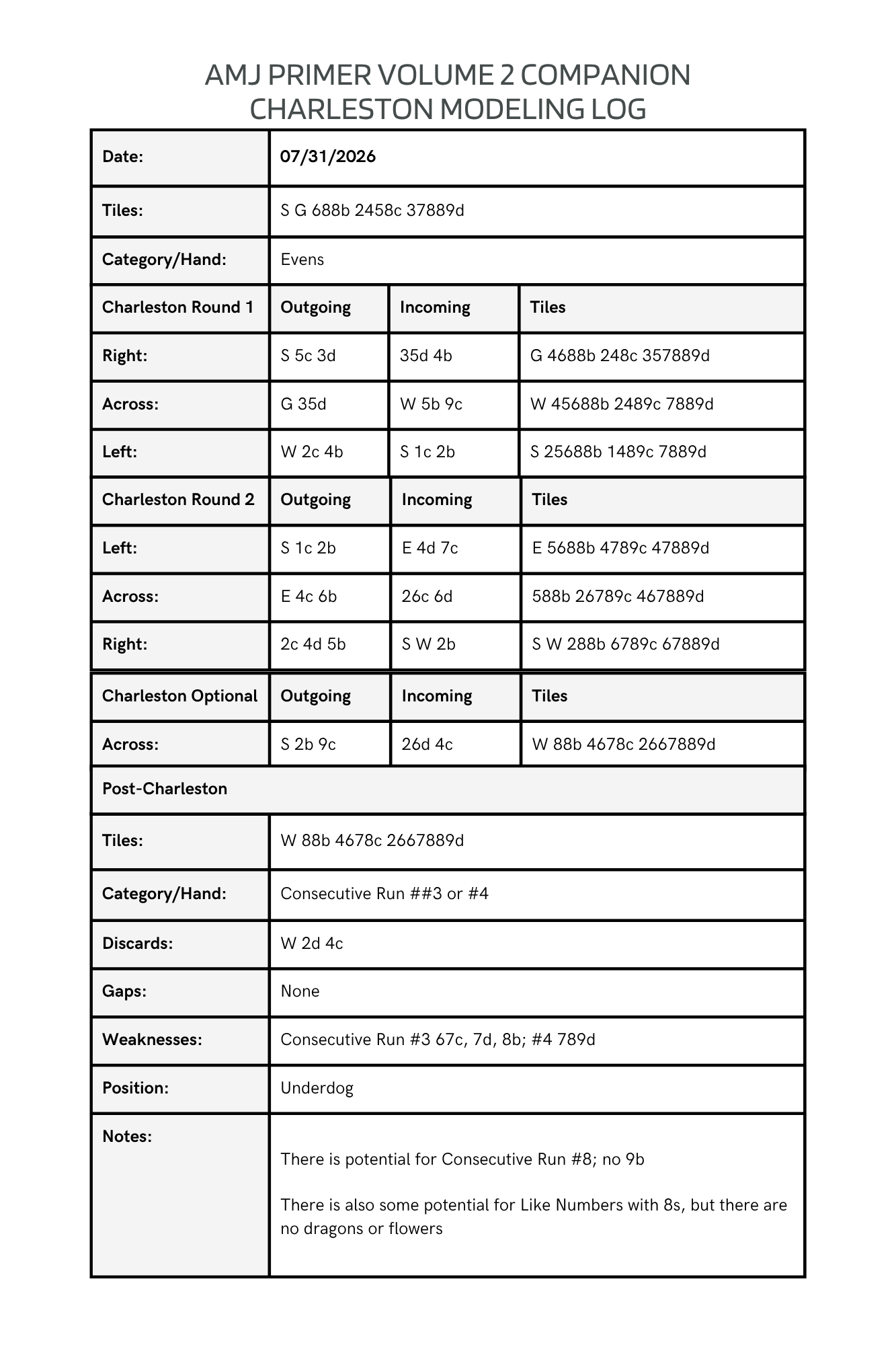
Charleston Modeling Log
Want to better understand your decision-making? The Charleston Modeling Log from the AMJ Primer Volume 2 POWER-UPS Companion lets you recreate an entire hand—from the initial deal through each Charleston exchange and into post-Charleston analysis. By recording the tiles you passed, received, and ultimately kept, you can identify patterns, evaluate your choices, and monitor your progress over time.
The log is also an excellent coaching tool. Because you can recreate the hand, you and your coach can revisit key decisions, explore alternative strategies, and gain insights that simply aren’t possible after a game has ended. It’s one of the most effective ways to accelerate your growth as a player.
Curious how much the Charleston really changes your starting position?
Try the Charleston Effect challenge and observe what happens before the first discard.